
Is It Torque Converter Shudder or Transmission Slipping?
Torque Converter Shudder or Transmission Slipping: What Are You Feeling?
A vibration appears while cruising. The vehicle feels as though it has crossed a strip of rough pavement, yet the road looks perfectly smooth. Another driver describes the same problem as a transmission slip. Someone else is convinced the engine is misfiring.
All three descriptions may sound reasonable from behind the wheel. They do not necessarily identify the same mechanical problem.
A torque converter shudder is one possible cause of vibration in an automatic transmission vehicle, but guessing from the sensation alone can lead to the wrong repair.
What the Torque Converter Does
A conventional automatic transmission uses a torque converter between the engine and transmission. It allows the engine to continue running while the vehicle is stopped and transfers power as the vehicle begins moving.
Many torque converters also contain a lockup clutch. Under suitable driving conditions, that clutch can reduce the amount of slip between the engine and transmission.
Automatic Transmission Exchange notes that the torque converter is an important source of heat and load within an automatic transmission, particularly in demanding applications. Its Xtreme Duty transmissions use upgraded converter and clutch components for towing, hauling and other high load use.
Shudder Can Feel Like Driving Over Rumble Strips
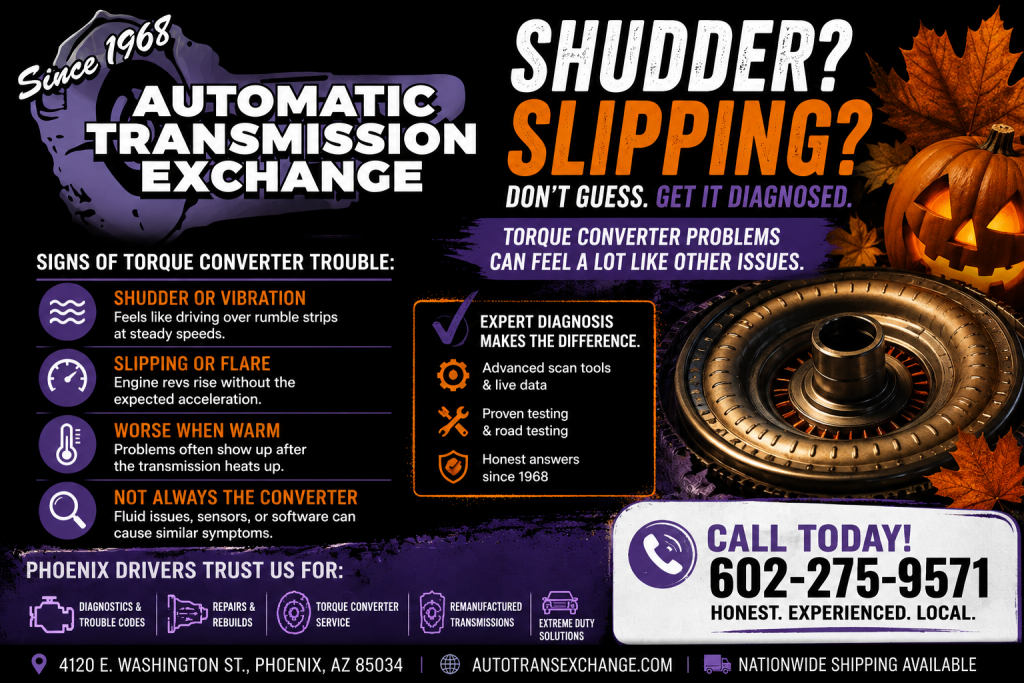
Torque converter clutch shudder is often described as a rapid vibration rather than a single hard shift.
General Motors has issued vehicle specific technical guidance describing some torque converter clutch complaints as a shake or shudder during light throttle driving, sometimes feeling as though the vehicle is travelling across rumble strips or rough pavement.
That description is useful, but it is not a universal home diagnostic test. The same GM bulletin specifically warns technicians that shudder can come from other conditions and directs them to confirm the cause through proper diagnostics.
Slipping Usually Feels Different
Transmission slipping commonly involves a mismatch between engine speed and vehicle response. The engine may rev higher without the expected increase in road speed, or the transmission may hesitate while applying a gear.
Automatic Transmission Exchange identifies rising engine speed without corresponding acceleration as one of the details drivers should report when transmission trouble develops.
A shudder, by contrast, can occur while the vehicle remains in gear and travelling at a fairly steady speed. Drivers may describe it as vibration, buzzing or repeated small surges.
Neither symptom should be ignored, particularly when it becomes more frequent or appears after the vehicle has warmed up.
Fluid Problems Can Mimic a Failed Converter
A shudder does not automatically mean the torque converter needs replacement.
Manufacturer service information provides good examples. Honda documented certain vehicles in which drivers could feel a torque converter lockup clutch judder, but the underlying issue involved deteriorated transmission fluid rather than physical torque converter failure.
General Motors has likewise issued model specific procedures in which fluid condition and fluid exchange were part of addressing confirmed torque converter clutch shudder.
Those procedures apply only to the vehicles identified in the respective bulletins. They should not be copied onto another make or transmission. What they demonstrate is why the correct fluid specification and accurate diagnosis matter.
An Engine Problem Can Feel Surprisingly Similar
A misfire, driveline vibration, worn mount or other mechanical problem can sometimes be mistaken for transmission shudder.
General Motors diagnostic guidance specifically tells technicians to distinguish torque converter clutch shudder from other vibration and drivability concerns.
That distinction can require a controlled road test and scan data. A technician may examine engine operating information, transmission command data and torque converter clutch slip while trying to reproduce the complaint.
Telling the shop precisely when the vibration occurs is useful. Note the approximate speed, whether the throttle is light or heavy, whether the vehicle is climbing and whether the vibration disappears when you accelerate or slow down.
Phoenix Heat Makes Early Diagnosis Worthwhile
Automatic Transmission Exchange has already documented how Phoenix heat and stop and go driving can expose transmission problems that become more noticeable after the fluid and components reach operating temperature.
If a shudder appears repeatedly, waiting for it to become a major slip or loss of drive rarely improves the situation. An inspection can determine whether the problem involves fluid, controls, the converter, internal transmission components or something outside the transmission altogether.
Have the Shudder Diagnosed Before Replacing the Converter
Automatic Transmission Exchange has served Phoenix drivers since 1968 and provides transmission diagnosis, torque converter work, rebuilding, replacement and heavy duty transmission solutions. If your car, SUV or truck is shuddering, slipping or vibrating under load, call 602 275 9571 before assuming the whole transmission or torque converter has failed. Proper testing can identify the source of the problem and help you choose the repair that actually fits the vehicle.
Live References
Automatic Transmission Exchange
Automatic Transmission Exchange Xtreme Duty Transmissions
Automatic Transmission Exchange Transmission Service and Repair
NHTSA GM Torque Converter Clutch Shudder Diagnostic Bulletin