
What Do Transmission Trouble Codes Really Mean?
What Do Transmission Trouble Codes Really Mean?
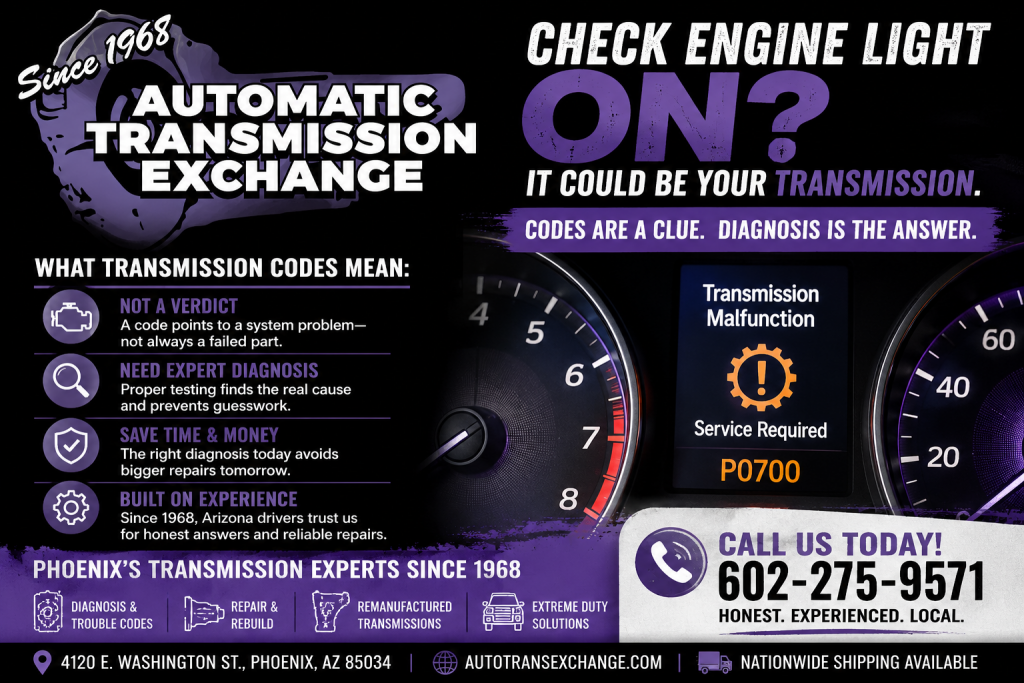
A check engine light appears, somebody plugs in a small scanner and a code such as P0700 appears on the screen. It is tempting to assume the vehicle has now diagnosed itself.
Modern vehicles are considerably more complicated than that. A diagnostic trouble code can provide an extremely useful direction, but it usually does not amount to a verdict on which component should be replaced. For Phoenix drivers experiencing harsh shifts, slipping, delayed engagement or a transmission warning message, reading the codes is often the beginning of diagnosis rather than the end.
A Trouble Code Records What the Computer Detected
Electronic transmissions use a network of sensors, solenoids, wiring and control modules to monitor operation. When the control system detects a condition outside its expected range, it may store a diagnostic trouble code.
Some codes relate to speed sensors. Others concern solenoid circuits, hydraulic control, gear ratios or torque converter operation. The symptoms accompanying them can include harsh shifting, delayed engagement, reduced performance or a warning light.
The important distinction is that the code describes what the computer observed. It does not necessarily prove why that condition occurred.
Manufacturer service information submitted to NHTSA illustrates the point. General Motors describes P0700 as a request from the transmission control module for illumination of the malfunction indicator lamp. The underlying fault still has to be identified through additional diagnosis.
The Same Code Can Have Different Causes
Suppose a code appears to involve a transmission control circuit. The cause might be a failed component, but wiring, connectors, voltage problems or software can also produce transmission related faults.
A Jaguar Land Rover technical bulletin, for example, documents vehicles that could store P0700 and P0715 while displaying a gearbox fault message because of a transmission control module software error. Another General Motors bulletin shows P0700 appearing alongside other faults caused by wiring problems elsewhere in the vehicle.
Those bulletins apply to particular vehicles, not every car on the road. They demonstrate an important principle: replacing a part simply because its name appears in a code description can become expensive guesswork.
A Basic Code Reader Has Limits
An inexpensive scanner can be useful when you want to know why a warning light appeared. It may provide a generic powertrain code and help you decide whether professional attention is needed.
A transmission specialist can go further. Depending on the vehicle and complaint, diagnosis may involve accessing the transmission control module, viewing live operating data, checking commanded and actual gear operation, examining transmission temperature and testing electrical circuits.
The vehicle also needs to be considered as a complete system. Automatic Transmission Exchange provides transmission work alongside drivetrain, engine and electrical diagnosis, which matters when a symptom that feels like transmission failure actually originates elsewhere.
Do Not Clear the Codes Before an Inspection
Erasing a trouble code may switch the warning light off temporarily, but it can also remove information that helps a technician understand when the problem occurred.
If the vehicle remains safe to operate, make a note of what you felt when the warning appeared. Was the transmission hot or cold? Were you accelerating, cruising or towing? Did it begin shifting harshly? Did Reverse take longer than normal to engage?
Automatic Transmission Exchange already advises drivers to pay attention to the precise conditions under which transmission symptoms appear because that information can help a technician reproduce the fault.
A Code Does Not Automatically Mean You Need a Transmission
One of the most important reasons to diagnose the vehicle properly is that not every transmission complaint requires a rebuild or replacement.
A sensor, wiring fault or other repair may solve some problems. Other vehicles may have serious internal damage requiring a rebuild or remanufactured unit. The decision should follow testing rather than precede it.
Automatic Transmission Exchange has remanufactured thousands of transmissions during more than five decades in business and tests completed units on its dynamometer. That capability becomes relevant when major internal work really is necessary.
Get the Code Diagnosed Before Buying Parts
Automatic Transmission Exchange provides transmission diagnostics, repair, rebuilding, remanufacturing and replacement for drivers throughout Phoenix and the surrounding Valley. If your check engine light or transmission warning has appeared, bring the code and the symptoms with you rather than buying parts based on the scanner description alone. Call 602 275 9571 to schedule an inspection and find out what the vehicle actually needs.
Live References
Automatic Transmission Exchange
Automatic Transmission Exchange Transmission Service and Repair
Automatic Transmission Exchange Automotive Service and Repair
NHTSA Technical Bulletin Showing P0700 and Wiring Related Faults